WASTEWATER TREATMENT SYSTEM RWANDA
A practical guide for commercial buildings, restaurants and decentralised projects.
Short answer: A reliable wastewater treatment system in Rwanda must be selected from actual flow, peak use, COD/BOD loading, available space and the authorised outlet. For commercial buildings, a professionally operated DEWAT system can be a practical septic-tank alternative when it includes biological treatment, verification and a maintenance contract.
What is a DEWAT system?
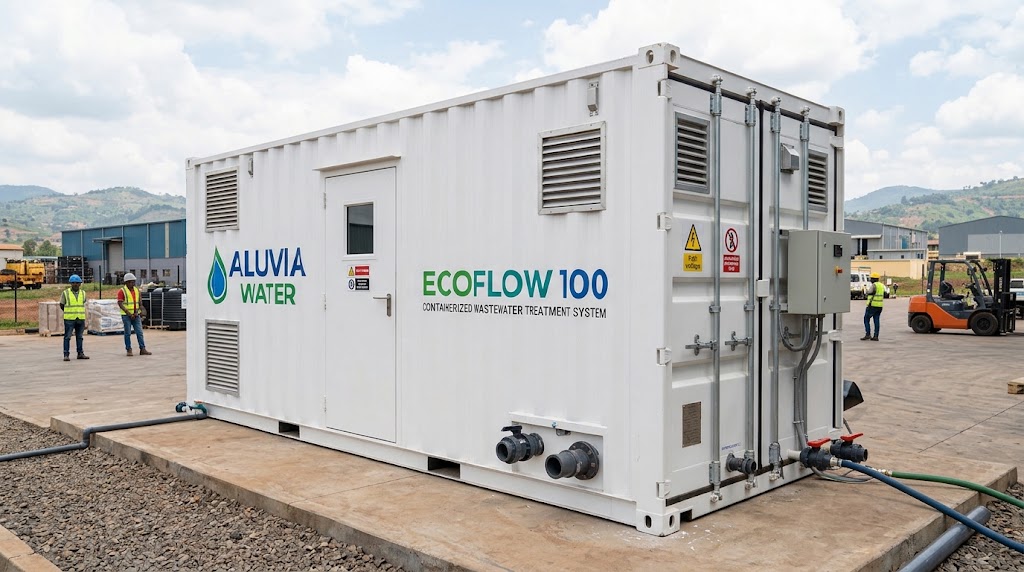
DEWAT means decentralised wastewater treatment. It treats wastewater close to the building or group of buildings that produces it. This can reduce dependence on repeated emptying and allow phased sanitation investment. ALUVIA offers surface, buried and concrete-integrated configurations, plus a fully containerized, plug-and-play DEWAT system from 100 PE for rapid professional deployment.
A septic-tank alternative for a commercial building
A septic tank mainly settles solids. A complete commercial treatment pathway adds controlled biological treatment, polishing, UV finishing where configured, monitoring and representative testing. That makes the treatment objective more visible and manageable. The correct solution still depends on project assessment and the permitted discharge or reuse route.
How to control sewage odor in commercial properties
Odor is often a warning sign of overloaded pretreatment, accumulated grease or solids, poor ventilation, interrupted biology or inadequate maintenance. Odor control starts with correct sizing and source control. Kitchens require a properly sized grease trap. ECOFLOW 25 combines the mandatory Grease Trap 560 Pro with dedicated Kitchen Premium maintenance.
Wastewater treatment maintenance contract in Africa
A treatment plant is an operating system, not a one-time installation. ALUVIA Care is mandatory because biological continuity, inspections, cleaning, sampling and corrective action protect performance. ECOFLOW 25 Kitchen Premium provides four service visits per month and includes one kilogram of ALUVIAMEDIA at 267,300 RWF per month before applicable taxes. Other ECOFLOW capacities use calculated ALUVIAMEDIA requirements and the selected Basic, Basic Plus or Premium service level.
Choosing a system in Rwanda and East Africa
- Confirm users, peak flow and operating schedule.
- Characterise wastewater, including COD/BOD, fats, solids and pH.
- Define the receiving environment and the applicable requirements.
- Select surface, buried, concrete-integrated or containerized installation.
- Commission under representative use and verify with laboratory results.
- Keep the maintenance contract active and retain records.
ALUVIA’s answer
ALUVIA provides ECOFLOW 25, 50, 100 and 250 PE systems, parallel configurations for larger projects, mandatory maintenance and project-specific verification. For an existing installation, the first on-site assessment is free.
Configure a Rwanda wastewater projectFrequently asked questions
Can treated wastewater be reused?
Depending on laboratory results, project design and authority approval, treated water may be considered for non-potable uses such as garden irrigation, washing and cleaning. The permitted route and numerical limits remain project-specific.
Does online pH and EC monitoring prove compliance?
No. Monitoring supports operation. Compliance is confirmed by the agreed representative sampling and laboratory testing.
SYSTÈME DE TRAITEMENT DES EAUX USÉES RWANDA
Guide pratique pour bâtiments commerciaux, restaurants et projets décentralisés.
Réponse courte : au Rwanda, un système fiable doit être sélectionné selon le débit réel, les pointes d’usage, la charge DCO/DBO, l’espace disponible et l’exutoire autorisé. Pour un bâtiment commercial, un système DEWAT exploité professionnellement peut constituer une alternative maîtrisée à la fosse septique lorsqu’il inclut traitement biologique, vérification et maintenance.
Qu’est-ce qu’un système DEWAT ?
DEWAT désigne le traitement décentralisé des eaux usées, réalisé près du bâtiment qui les produit. ALUVIA propose des configurations en surface, enterrées et intégrées au béton, ainsi qu’un système DEWAT entièrement conteneurisé, plug-and-play à partir de 100 EH.
Alternative à la fosse septique pour bâtiment commercial
Une fosse septique assure principalement la décantation. Un parcours complet ajoute traitement biologique, polissage, finition UV selon la configuration, suivi et analyses représentatives. Le choix final dépend toujours de l’évaluation du projet et de la voie de rejet ou réutilisation autorisée.
Maîtrise des odeurs
Les odeurs peuvent révéler une surcharge, des graisses accumulées, une biologie interrompue ou une maintenance insuffisante. Les cuisines exigent un bac à graisses correctement dimensionné. ECOFLOW 25 associe le Grease Trap 560 Pro obligatoire à la maintenance Kitchen Premium.
Contrat de maintenance des eaux usées en Afrique
ALUVIA Care est obligatoire afin de soutenir la continuité biologique, les inspections, le nettoyage, l’échantillonnage et les actions correctives. ECOFLOW 25 comprend 1 kg d’ALUVIAMEDIA dans la maintenance Kitchen Premium à 267 300 RWF par mois avant taxes applicables.
Choisir au Rwanda et en Afrique de l’Est
- Confirmer les usagers, le débit et les pointes.
- Caractériser DCO/DBO, graisses, solides et pH.
- Définir l’exutoire et les exigences applicables.
- Choisir l’installation.
- Mettre en service et vérifier en laboratoire.
- Maintenir le contrat actif et conserver les registres.
La réponse ALUVIA
ECOFLOW 25, 50, 100 et 250 EH, configurations parallèles pour les grands projets, maintenance obligatoire et vérification adaptée au projet.
Configurer un projet au RwandaSISITEMU YO GUTUNGANYA AMAZI MABI MU RWANDA
Amabwiriza y’inyubako z’ubucuruzi, resitora n’imishinga ya decentralised wastewater treatment.
Igisubizo kigufi: sisitemu nziza mu Rwanda ihitamo hashingiwe ku mazi nyayo, ibihe by’akazi kenshi, COD/BOD, umwanya uhari n’aho amazi yemerewe gusohokera. Ku nyubako z’ubucuruzi, DEWAT ikorwa neza ishobora kuba igisubizo kirenze septic tank gusa.
DEWAT ni iki?
DEWAT ni uburyo bwo gutunganya amazi mabi hafi y’inyubako ayatanga. ALUVIA itanga sisitemu zo ku butaka, mu butaka no muri beton, ndetse na DEWAT yuzuye muri kontineri, plug-and-play kuva kuri 100 PE.
Igisubizo gisimbura septic tank ku nyubako y’ubucuruzi
Septic tank ahanini itandukanya imyanda iremereye. Sisitemu yuzuye yongeraho biological treatment, polishing, UV iyo yatoranyijwe, monitoring no gupima muri laboratoire.
Kurwanya impumuro mbi
Impumuro ishobora guterwa n’ubushobozi budahagije, amavuta menshi, biological process ihagaze cyangwa maintenance idahagije. Igikoni kigomba kugira grease trap ikwiye. ECOFLOW 25 ijyana na Grease Trap 560 Pro na Kitchen Premium maintenance.
Amasezerano ya maintenance muri Afurika
ALUVIA Care ni ngombwa kugira ngo biological treatment ikomeze, sisitemu igenzurwe kandi ibibazo bikosorwe. ECOFLOW 25 ifite 1 kg ya ALUVIAMEDIA muri Kitchen Premium ya 267,300 RWF buri kwezi mbere y’imisoro ikwiye.
Igisubizo cya ALUVIA
ECOFLOW 25, 50, 100 na 250 PE, sisitemu zihuza ku mishinga minini, maintenance ya ngombwa no kugenzura imikorere.
Tegura umushinga mu Rwandaنظام معالجة مياه الصرف في رواندا
دليل عملي للمباني التجارية والمطاعم ومشاريع المعالجة اللامركزية.
الإجابة المختصرة: يجب اختيار النظام في رواندا وفق التدفق الفعلي وفترات الذروة وحمل COD/BOD والمساحة المتاحة ومسار التصريف المعتمد. يمكن لنظام DEWAT مُدار مهنياً أن يكون بديلاً أكثر تحكماً من خزان الصرف وحده.
ما نظام DEWAT؟
هو نظام معالجة لامركزي يعالج مياه الصرف بالقرب من المبنى الذي ينتجها. تقدم ALUVIA تركيبات سطحية ومدفونة ومدمجة في الخرسانة، إضافة إلى نظام DEWAT داخل حاوية بالكامل وجاهز للتوصيل والتشغيل ابتداءً من 100 PE.
بديل خزان الصرف للمبنى التجاري
يقوم الخزان أساساً بترسيب المواد الصلبة، بينما يضيف المسار المتكامل معالجة بيولوجية وتلميعاً وإنهاءً بالأشعة فوق البنفسجية عند اختياره، ومراقبة واختبارات مخبرية.
التحكم في روائح الصرف
قد تشير الروائح إلى زيادة الحمل أو تراكم الدهون أو انقطاع المعالجة البيولوجية أو ضعف الصيانة. يجب أن تحتوي المطابخ على مصيدة دهون مناسبة. يجمع ECOFLOW 25 بين Grease Trap 560 Pro الإلزامية وصيانة Kitchen Premium.
عقد صيانة معالجة مياه الصرف في أفريقيا
صيانة ALUVIA Care إلزامية لدعم الاستمرارية البيولوجية والفحص والتنظيف والإجراءات التصحيحية. يشمل ECOFLOW 25 مقدار 1 كغ من ALUVIAMEDIA ضمن Kitchen Premium بسعر 267,300 فرنك رواندي شهرياً قبل الضرائب المطبقة.
حل ALUVIA
أنظمة ECOFLOW 25 و50 و100 و250، وتركيبات متوازية للمشاريع الأكبر، وصيانة إلزامية وتحقق خاص بكل مشروع.
إعداد مشروع في رواندا