Buying a wastewater treatment plant is a long-term investment. The selected system should not only satisfy today’s operational needs but also remain reliable throughout its expected service life. The purchase price is only one part of the decision. Operating costs, maintenance requirements, energy consumption and future expansion often have a greater influence on the total cost of ownership.
A wastewater treatment plant should be selected after evaluating the characteristics of the wastewater, the available space, operational requirements and long-term objectives of the facility. A system that performs well in one project may not be suitable for another.
The following considerations provide a practical framework for owners, architects, developers and facility managers before making a purchasing decision.
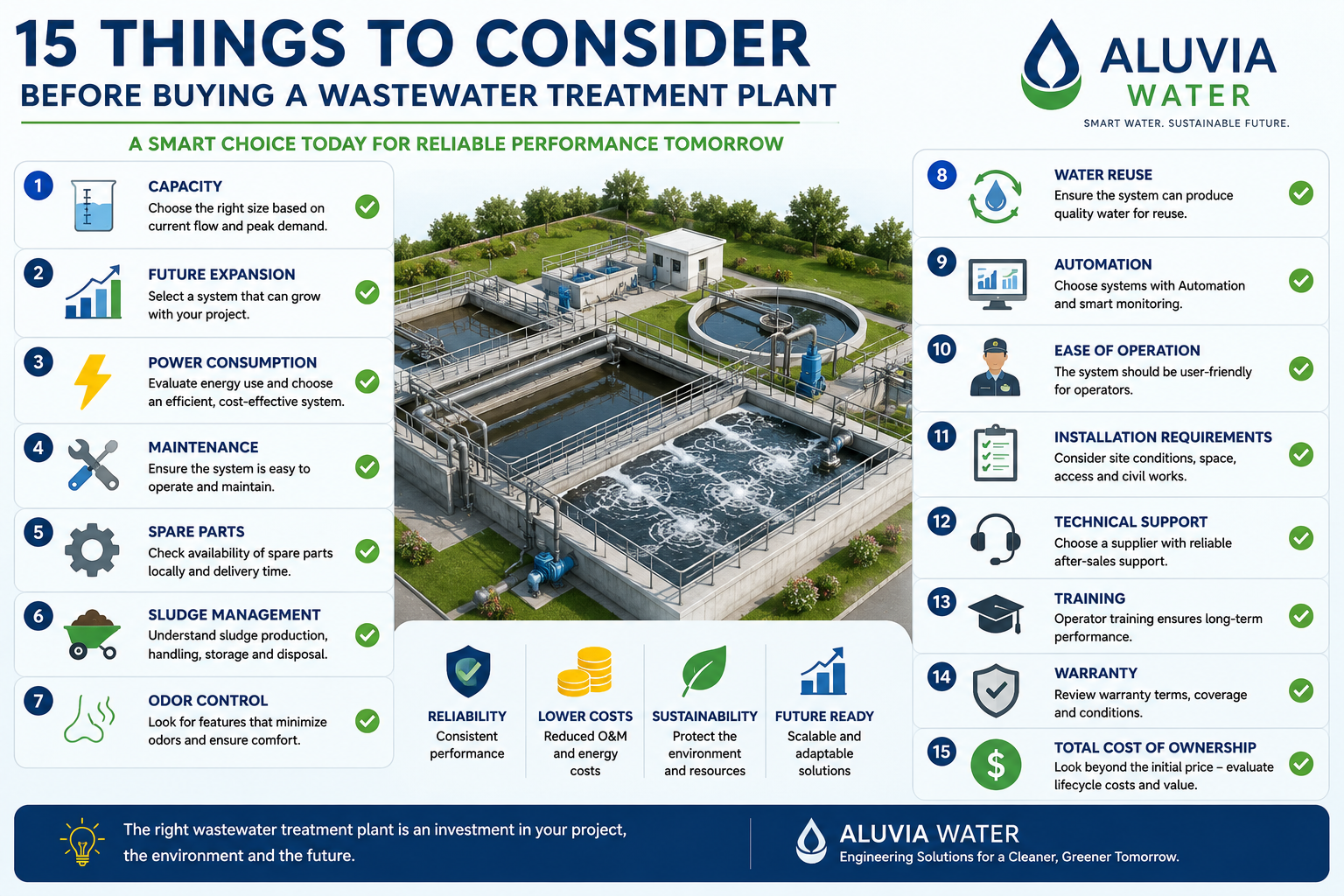
1. Define the Required Treatment Capacity
Capacity is the starting point for every project.
The treatment plant should be designed according to the expected wastewater flow rather than building size alone. Hotels, hospitals, schools, residential developments and industrial facilities all produce different wastewater volumes and characteristics.
An undersized plant may become overloaded, while an oversized system may operate inefficiently.
The design should consider both average daily flow and expected peak demand.
2. Consider Future Expansion
Buildings rarely remain unchanged throughout their lifetime.
Hotels may add rooms. Residential developments may construct additional blocks. Hospitals may increase bed capacity. Industries often expand production.
Selecting a treatment plant that allows future expansion can reduce future capital expenditure.
Expansion may involve:
- Additional treatment modules
- Larger blowers
- Extra tanks
- Increased pumping capacity
Planning for future growth is generally less expensive than replacing the entire system.
3. Understand the Wastewater Characteristics
Not all wastewater is the same.
Domestic sewage differs significantly from wastewater generated by hospitals, restaurants, factories or food processing facilities.
The treatment technology should match the characteristics of the wastewater.
A detailed engineering assessment before purchase helps avoid inappropriate system selection.
4. Evaluate Power Consumption
Electricity represents one of the largest operating costs of many wastewater treatment plants.
Different technologies require different amounts of energy.
Before purchasing, request information regarding:
- Blower power
- Pump power
- Daily operating hours
- Estimated annual electricity consumption
Lower energy demand often reduces operating costs over many years.
5. Review Maintenance Requirements
Every treatment plant requires maintenance.
The important question is not whether maintenance is required but how frequently and how easily it can be performed.
Ask whether routine servicing includes:
- Cleaning
- Equipment inspection
- Lubrication
- Calibration
- Sludge removal
- Component replacement
Simple maintenance procedures generally improve long-term reliability.
6. Confirm Spare Parts Availability
A treatment plant may operate for twenty years or more.
Replacement parts should remain available throughout the life of the installation.
Before purchasing, confirm:
- Local spare parts availability
- Delivery times
- Standard components
- Manufacturer support
Systems that rely on proprietary components may experience longer repair times.
7. Consider Sludge Management
Every biological treatment system produces sludge.
Effective sludge management should be considered during the design stage.
Questions to ask include:
- How often will sludge require removal?
- What volume is produced?
- Is sludge storage provided?
- How will sludge be disposed of?
Good sludge management contributes directly to stable plant performance.
8. Evaluate Odour Control
Odour is one of the most common complaints associated with poorly operated wastewater systems.
A well-designed treatment plant should minimise odour under normal operating conditions.
Consider whether the design includes:
- Adequate aeration
- Proper ventilation
- Covered tanks where appropriate
- Good hydraulic circulation
Odour control improves both environmental conditions and user satisfaction.
9. Consider Water Reuse Opportunities
Treated wastewater may have value.
Depending on the treatment process and applicable regulations, treated water may be suitable for non-potable applications such as:
- Landscape irrigation
- Toilet flushing
- Road cleaning
- Dust suppression
- Cooling systems
Planning for future reuse may improve water efficiency and reduce potable water demand.
10. Review the Level of Automation
Automation improves operational control.
Modern systems may include:
- Automatic pump control
- Level sensors
- Flow monitoring
- Alarm notifications
- Remote monitoring
- Energy monitoring
Automation supports preventive maintenance and reduces unexpected equipment failures.
11. Assess Ease of Operation
The best treatment plant is one that operators can manage confidently.
Complex systems requiring highly specialised intervention may not always be appropriate.
Operators should easily understand:
- Daily inspection procedures
- Alarm response
- Basic maintenance
- Routine adjustments
User-friendly systems generally perform more consistently over time.
12. Examine Installation Requirements
Installation conditions differ from one project to another.
Consider:
- Available land
- Excavation requirements
- Access for maintenance
- Pipe routing
- Electrical connections
- Future accessibility
Construction constraints should be evaluated before equipment selection.
13. Ask About Technical Support
Purchasing equipment is only the beginning of the relationship with the supplier.
Reliable technical support remains important throughout the operational life of the treatment plant.
Useful services may include:
- Commissioning
- Operator training
- Preventive maintenance
- Emergency assistance
- Performance assessment
Long-term technical support often contributes to more reliable operation.
14. Review Warranty Conditions
Warranty terms should be understood before signing a contract.
Review:
- Warranty duration
- Equipment covered
- Exclusions
- Response procedures
- Spare parts policy
A warranty provides additional confidence, but routine maintenance remains essential regardless of warranty coverage.
15. Look Beyond the Purchase Price
The lowest purchase price does not always represent the lowest lifetime cost.
A comprehensive evaluation should include:
- Installation cost
- Electricity consumption
- Maintenance
- Spare parts
- Sludge management
- Equipment lifespan
- Technical support
Evaluating the total cost of ownership provides a more realistic basis for investment decisions than purchase price alone.
Final Thoughts
Selecting a wastewater treatment plant requires careful technical and financial evaluation. Capacity, operating costs, maintenance, energy efficiency, automation and future expansion all influence long-term performance. A well-designed system should provide reliable treatment, manageable operating costs and the flexibility to adapt as a facility evolves.
Before making a final decision, property owners should seek independent engineering advice and compare complete lifecycle costs rather than focusing solely on initial investment.
At ALUVIA Water, we assist developers, architects, hotels, hospitals, industries and commercial facilities in selecting wastewater treatment solutions that match project requirements, operational objectives and long-term sustainability goals. Our engineering approach considers not only today’s needs but also the future performance of the entire wastewater treatment system.